
Article by Anthony Betia
Effects of Road Widening
Authorities and city planners have traditionally advocated for road expansion as an effective solution to increasing traffic congestion. The reasoning is clear and attractive: expand the road, boost capacity, and lessen congestion. At first, this method usually seems effective. Journey durations might enhance, congestion could diminish, and motorists may find momentary respite. Nonetheless, this enhancement seldom endures, and the core issue stays unaddressed.
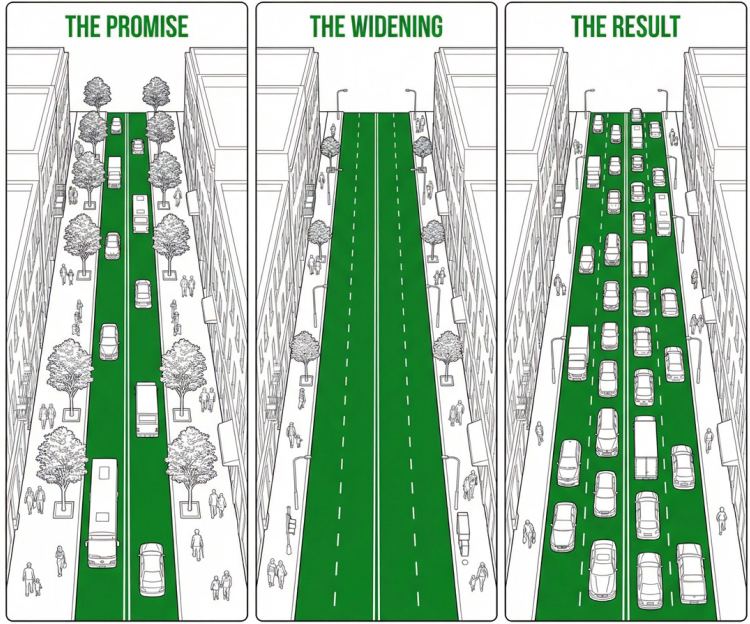
When roads are enlarged, additional room is generated for vehicles, yet this enlargement frequently incurs a considerable expense. Trees are cut down, sidewalks are scaled back or removed, and bike paths are compromised to allow for extra lanes. As a result, city settings turn out to be less accommodating for pedestrians and harder to navigate for other forms of transport. Although the aim is to enhance mobility, the outcome is a city that favors cars over individuals.
Eventually, the increased road capacity starts to draw in more drivers. This occurrence is referred to as induced demand, where expanding the availability of road space results in a rise in its utilization. Drivers who once steered clear of busy routes might come back, commuters could transition from public transport to personal cars, and people might opt for journeys they typically wouldn’t have made. Consequently, the newly widened roads slowly become congested again, returning traffic levels to their previous state—or even more severe.
Grasping induced demand is crucial for successful urban development. Widening roads does not resolve congestion; rather, it initiates a cycle that continues it. Roads are widened, traffic briefly gets better, more drivers start using the roads, and congestion eventually returns. This pattern results in ongoing infrastructure expenditure without providing enduring solutions, rendering it economically wasteful and unsustainable over time.
Apart from traffic jams, expanding roads brings numerous unforeseen effects that impact the general quality of life in urban areas. Diminished pedestrian areas heighten safety hazards, and the elimination of trees and green spaces leads to environmental decline. Moreover, the expansion of paved areas heightens urban heat, resulting in cities that are warmer and less pleasant. Sound and air pollution increase, further reducing the enjoyment of urban living conditions.
Better Alternatives
Instead of concentrating only on enlarging roadways, cities can implement more efficient and sustainable approaches to tackle congestion. Funding public transportation, creating dedicated bike lanes, and encouraging walkable neighborhoods can greatly lessen dependence on personal vehicles. Additionally, traffic demand management techniques can enhance current infrastructure without requiring expensive expansions. These methods emphasize the flow of individuals over merely vehicles, leading to more equitable and vibrant urban areas.
Ultimately, the facts are evident: expanding roads is not a sustainable fix for traffic jams. Although it might offer short-term relief, induced demand swiftly negates any benefits. Traffic increases, walkable areas diminish, and urban environments become noisier, warmer, and less focused on people. To develop genuinely sustainable urban areas, it is crucial to go beyond enlarging roads and adopt strategies that focus on individuals, accessibility, and enduring quality of life.