
MANILA, Philippines — Iran will permit the secure passage of Philippine-flagged ships and all Filipino sailors through the Strait of Hormuz after senior discussions initiated by President Ferdinand Marcos Jr.
Secretary of Foreign Affairs Ma. Theresa Lazaro stated she had a “very fruitful” phone call on Maundy Thursday with Iranian Foreign Minister Seyed Abbas Araghchi to talk about enhancing bilateral cooperation in all areas.
“During the conversation, the Iranian Foreign Minister guaranteed the secretary that Iran will permit the secure, unimpeded, and swift transit through the Strait of Hormuz of Philippine-registered ships, energy supplies, and all Filipino maritime workers,” the Department of Foreign Affairs (DFA) stated.
Lazaro stated that the “positive” advancement was crucial for the Philippines, as it would guarantee the safety of Filipino seafarers working in the Middle East and assist in securing the nation’s energy resources.
In a message on her verified X account, Lazaro remarked about her conversation with Araghchi: “Following our recent discussions, we achieved a constructive consensus regarding the safety of our seafarers and the reliability of our energy supply.” Appreciative of the kind atmosphere of collaboration.
The DFA stated that Manila and Tehran have reiterated their dedication to “sustaining excellent relations and reaching enduring peace through ongoing dialogue and diplomacy.”
The advancement positions the Philippines alongside the Asian nations permitted by the Iranian government to transit through the Strait of Hormuz.
Lazaro spoke with the Iranian foreign minister a day after her meeting with Energy Secretary Sharon Garin and Iranian Ambassador to the Philippines Yousef Esmaeilzadeh on Wednesday.
At Marcos’ instruction, Manila asked Tehran to officially label the Philippines as a “non-hostile” nation to guarantee the safe transit of ships heading to the Philippines through the Strait of Hormuz.
Palace Press Officer Claire Castro stated that the Department of Energy (DOE) is completing the arrangements for the “immediate transmission” of information regarding the relevant vessels after the discussion with the Iranian ambassador.
Castro mentioned that Esmaeilzadeh highlighted Tehran’s expectation of our engagement and reiterated their eagerness to support the Philippines with our particular needs.
Manila has consented to direct all specific requests through formal diplomatic pathways to accelerate processing.
Marcos previously stated that the nation possesses sufficient fuel to last until the end of June. Regardless, he directed the DOE to obtain more fuel supplies to increase the nation’s reserves, referencing uncertainties in the conflict in the Middle East.
The Philippines relies on imports for 98 percent of its crude oil from the Middle East, which is currently consumed by one of the globe’s most severe conflicts after last month‘s assaults by the U.S. and Israel on Iran.
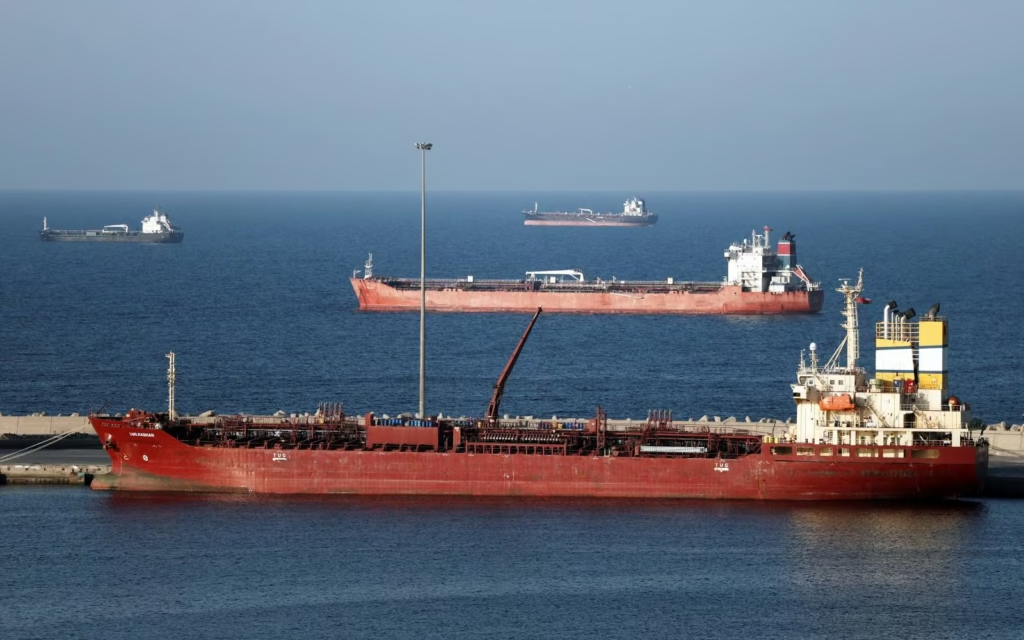
The conflict has resulted in the obstruction of the Strait of Hormuz, which carries one-fifth of the global oil supply.
Iran has leveraged its control over the narrow waterway as a negotiation tool, insisting on international acknowledgment of its authority over the strait as one of five prerequisites for concluding the war.
The Philippines is a strong defense partner of the United States but is not engaged in the conflict with Iran.